
Last week, I created a master list of Messier Objects witht he promise that thete would soon be links to photos populating the list. Well, the first round of links have vbeen posted for over 3 dozen of the Messier objects, so why not revisit the list and browse through the photos? Needless to say, as I shoot more 'M' objects, the amount of links on this list will continue to grow, so keep checking back, clicking on the 'educational' page, which is wher the list can be found.
Humble requests:
If you found this informative (or at least entertaining), help me pay my bills and check out my Examiner pages for photography and astronomy for more great stuff.
Think this was cool? Why not tell a friend?
For something even better, become a follower.
Wednesday, November 17, 2010


Sunday, November 14, 2010
Examiner for Week of 11/7
Another week, anopther Examiner roundup.
Astronomy
Featured sight for week of 11/7: early nights
November featured constellation: Perseus
Carl Sagan Day
Comet Hartley in motion
How the elections could shake up NASA
November featured sight: the far away, great colliding galaxy in Andromeda
Paper airplane in space
“UFOs” set to return
Photography
See Black Friday ads now
Last chance to capture fall colors
Ken Rockwell, DXO review Nikon D7000
Bed Bug registry creates buzz
Digital Photography Review tests the Canon 60D
Get the scoop on Target's Black Friday ad
High-speed cameras reveal physics of how cats drink
Humble thanks and requests:
If you clicked on any of the above Examiner articles, you're helping me pay my bills. Thank you!
Know someone who misses my stuff or you think would find it interesting? Spread the word!
Like this, why not follow this blog?
Astronomy
Featured sight for week of 11/7: early nights
November featured constellation: Perseus
Carl Sagan Day
Comet Hartley in motion
How the elections could shake up NASA
November featured sight: the far away, great colliding galaxy in Andromeda
Paper airplane in space
“UFOs” set to return
Photography
See Black Friday ads now
Last chance to capture fall colors
Ken Rockwell, DXO review Nikon D7000
Bed Bug registry creates buzz
Digital Photography Review tests the Canon 60D
Get the scoop on Target's Black Friday ad
High-speed cameras reveal physics of how cats drink
Humble thanks and requests:
If you clicked on any of the above Examiner articles, you're helping me pay my bills. Thank you!
Know someone who misses my stuff or you think would find it interesting? Spread the word!
Like this, why not follow this blog?
Friday, November 12, 2010
Charles Messier and His List of Annoying Objects
18th century French astronomer Charles Messier was a man with a mission: to find comets. More so than now (we have much better optics today), finding a comet was a real big deal in the early part of the telescope era. For some countries, having a long list of comet discoveries was a direct measure of a nation's scientific achievement. Needless to say, the more comets discovered by a country's astronomers, the better.
For the French, Charles Messier was one of their star comet finders. During his career, Messier found 13 comets. His record of discovery was more amazing given the primitive sate of telescope optics at the time. However, as good of an astronomer as Messier was, he wasn't perfect.
Throughout his years of observing, Messier found himself coming across objects that looked like comets but stayed stationary in the sky, which told him that these objects, whatever they were, were not comets. In time, Messier got so annoyed with these troublesome comet look-alikes that he started making a list of them. In time, Messier would catalog over 100 objects that looked like, but weren't comets.
How ironic that today that, rather than look for comets, most astronomers spend time looking at Messier's list of annoying objects.
The Grand List of Messier Objects.
Below is the list of Messier objects, with a small description and where they are located and in what season they are best seen. Messier objects in blue are linked to a photo. As I shoot more “M” objects, more objects will have links. Who knows, if I get really ambitious, they may get their own pages with pictures and observing info.
NOTE: When describing what these objects look like in telescopes, using a mid-sized scope 4” refractor, 6” reflector as a basis, with 40x being low, 100x being mid, and 200x high-power.
M1 (Crab Nebula), winter, located in Cancer, 9th magnitude remnant of the supernova seen in 1054. Small, dim smudge in scopes.
M2, fall, 7th magnitude globular cluster in Aquarius, medium-sized cluster in area, relatively high surface brightness.
M3, spring, 7th magnitude globular Cluster technically in Coma Bernices, but often found by star hopping from Arcturus, medium-sized with medium surface brightness
M4, summer, 7th magnitude globular cluster in Scorpius less than a degree from Antares, large in area with low surface brightness owning to its diffuse (for a globular) nature
M5, summer, 7th magnitude globular cluster in Serpens, large in area and medium in surface brightness, one of the sky's best globular clusters
M6 (Ptolemy's Cluster), summer, 4th magnitude open cluster just off the Scorpion's stinger, large in area and best seen in binoculars or extreme low power telescope eyepieces
M7 (Butterfly Cluster), summer, 5th magnitude open cluster in Scorpius just off the scorpion's stinger, best in scopes at low power, nice in binoculars, too.
M8 (Lagoon Nebula), summer, 5th magnitude nebula with open cluster in Sagittarius just above the Teapot's spout, a great low power telescope object, nice in binoculars from dark skies, too. Gas cloud shape is obvious in scopes.
M9, summer, 9th magnitude globular cluster in Ophiuchus
M10, summer, 7th magnitude globular cluster in Ophiuchus
M11 (Wild Duck Cluster), summer, 6th magnitude, tight open cluster technically in Scutum, but easily found just off of Aquila's tail, best at low to medium power. A beautiful splash of blue stars, this is a deep sky favorite for many
M12, summer, 8th magnitude globular cluster in Ophiuchus
M13 (Great Hercules Cluster), summer, 5th magnitude globular cluster with large area and medium surface brightness within the Keystone, widely considered the best globular in the mid-Northern sky, pick your power!
M14, summer 9th magnitude globular cluster in Ophiuchus
M15, summer, 7th magnitude globular cluster in Pegasus, find it by star hopping off the nose of the horse. Very similar to M2 in appearance. Medium power is best.
M16 (Eagle Nebula), summer, 6th magnitude nebula with open cluster about half way between the top of the Teapot and end of Aquila's tail. Faint nebulosity in scopes, the cluster is more conspicuous. Use low power.
M17 (Omega/Swan Nebula), summer, 6th magnitude, aptly named, this small but high-surface brightness nebula looks like what its name suggests. Located about half way between the top of the Teapot and end of Aquila's tail. Use low to medium power.
M18, 8th magnitude open cluster in Sagittarius
M19, 8th magnitude globular cluster in Ophiuchus
M20 (Trifid Nebula), summer, 6th magnitude, to find the Trifid by coming up a degree off the tip of the Lagoon. Seen as a round, hazy patch in small scopes, from a dark sky sight, it can also be good in binoculars.
M21, summer, 6th magnitude, small open cluster just above and left of the Trifid consisting of around two dozen stars is often, and unfortunately ignored in the wake of its nebular neighbor. Easily fits in a low power field with the Trifid.
M22, summer, 5th magnitude globular cluster located about 3 degrees left of the top of the Teapot's lid. Large in surface area, medium in brightness, this would undoubtedly rival M13 for best Northern globular if it wasn't located in the heart of the Milky Way. Pick your power.
M23, 6th magnitude open cluster in Sagittarius
M24, 4th magnitude star cloud in Sagittarius
M25, summer, 6th magnitude open cluster located about 5 degrees left and 5 degrees up from the top of the Teapot's lid. A nice splash of gold and blue stars in low power telescopic fields.
M26, 9th magnitude open cluster in Scutum
M27 (Dumbbell Nebula), summer, 7th magnitude, located just off the tip of Saggita, the aptly-named nebula is easy to find. Smallish in area but with high surface brightness, low to medium power views are the most pleasing and best reveal this nebula's distinctive shape.
M28, summer, 8th magnitude, a tiny globular cluster located almost on top of the star that makes the pinnacle of the teapot's lid, the small, low surface brightness globular cluster is one of the easiest deep sky objects in the sky to find.
M29, 9th magnitude open cluster in Cygnus
M30, 8th magnitude globular cluster in Capricorn
M31 (Great Andromeda Galaxy) fall, 3rd magnitude, located by star hopping two stars left and two up from third base on the Great Square, one can't help but miss the Andromeda Galaxy, which reveals itself as a distinct oval patch in binoculars and in scopes at low power. For the average person, this is also the most distant object that can be seen with the naked eye.
M32, 10th magnitude dwarf elliptical galaxy, a satellite of M31
M33 (Triangulum Galaxy), fall, 6th magnitude, found by star hopping two left from third base and then down about 5 degrees, this spiral galaxy is large but has extremely low surface brightness, requiring dark skies and/or a large scope. Look for a faint spiral pattern.
M34, fall, 6th magnitude, located about 5 degrees up from Algol, this open cluster is another easy to find object. Best seen at low power in a scope, M34 reveals itself to be a loose cluster of a few dozen blue stars.
M35, winter, 5th magnitude, located at the tip of Castor's foot, it's just about impossible top miss M35, a large, dense open cluster. Low power in a scope will reveal around 100 stars. As an added bonus, look for the tiny NGC open cluster right next to M35 itself.
M36, winter, 6th magnitude, Located in Auriga, the M36 open cluster is easy to sweep up in low power telescopic views, in which it is best seen. Medium tightness cluster composed of blue stars set against a somewhat dense stellar background.
M37, winter, 6th magnitude, located just below Auriga, the M37 open cluster is widely considered to be the jewel of the Auriga Trio. At low power, the large cluster transforms from hazy patch into medium-sized, somewhat on the tight side grouping of stars.
M38, winter, 7th magnitude, located in Auriga, M38 is somewhat difficult to pass by at low telescopic power because it is made up of a rather dense collection of several dozen stars. Try and visually spot its neighboring NCG open cluster, too!
M39, 5th magnitude open cluster in Cygnus
M40, 9th magnitude, a Messier mistake, a double star in Ursa Major
M41, winter, 4th magnitude open cluster, to find, drop down a few degrees from impossible to miss Sirius, the brightest star in the sky. At low to medium power in a telescope, the medium-sized cluster reveals itself to be composed of a few dozen deep blue stars.
M42 (Great Orion Nebula), winter, 4th magnitude, impossible to miss, just look for the hazy patch in Orion's Sword to find M42, the brightest nebula in the sky. At low power, see how far you can follow the glowing gas filaments. At high power, see how many stars you can split in the Trapezium.
M43, winter, 7th magnitude, a sub nebula of M42, this could really be called M42A
M44 (Beehive Cluster), winter, 5th magnitude, find M44 by finding the center of Cancer and looking for the sprinkling of stars. The second largest open cluster after the Pleiades, M44 is great in both scopes at low power and in binoculars.
M45 (The 7 Sisters/Pleiades), winter, 1st magnitude, the largest open cluster in the sky, the Pleiades are spectacular in both scopes and binoculars, revealing itself to be a lot more than the legendary 7 sisters! The cluster is the large, hazy patch seen with the naked eye below the feet of Perseus.
M46, winter, 6th magnitude open cluster in Puppis
M47, winter, 4th magnitude open cluster in Puppis
M48, spring, 5th magnitude open cluster in Hydra
M49, spring, 10th magnitude galaxy in Virgo
M50, winter, 7th magnitude open cluster in Monoceros
M51 (Whirlpool Galaxy), spring, 8th magnitude, one of the most spectacular and nearest galaxies, find the Whirlpool by dropping about 2 degrees down from the end of the Big Dipper's handle. Large but with low surface brightness, a low power eyepiece should reveal a distinct spiral along with a companion galaxy.
M52, fall, 8th magnitude open cluster in Cassiopeia, lots of blue stars of rather low brightness, large in area, find it by star hopping off the tall side of the 'W.'
M53, spring, 8th magnitude globular cluster in Coma Berenices
M54, summer, 8th magnitude globular cluster in Sagittarius
M55, summer, 7th magnitude globular cluster in Sagittarius
M56, summer, 9th magnitude, a small globular cluster in Lyra, find M56 by stopping about half way between the bottom star of Lyra and Alberio, the head of Cygnus. To see any appreciable detail, you'll need mid to high telescopic powers.
M57 (Ring Nebula), summer, 8th magnitude, a cool, appropriately named planetary nebula, find the Ring by parking your scope directly between the bottom stars of Lyra. Extremely small but of high surface brightness, use mid to high power to resolve the cosmic donut.
M58, spring, 11th magnitude galaxy in Virgo
M59, spring, 11th magnitude galaxy in Virgo
M60, spring, 10th magnitude galaxy in Virgo
M61, spring, 10th magnitude galaxy in Virgo
M62, summer, 8th magnitude globular cluster in Ophiuchus
M63, (Sunflower Galaxy), spring, 8th magnitude galaxy in Canes Venatici
M64 (Black Eye Galaxy), spring, 9th magnitude, seen at low power, the galaxy lives up to its name as it features a dark spot among its otherwise medium bright body.
M65, spring, 10th magnitude, edge-on galaxy that is part of the famous Leo Trio, find M65 by coming about 5 degrees down from Denebola in the back of Leo the Lion.
M66 spring, 10th magnitude galaxy that is part of the famous Leo Trio. Positioned at about the same angle as Andromeda, find M66 by coming about 5 degrees down from Denebola in the back of Leo..
M67, winter, 7th magnitude open cluster in Cancer
M68, spring, 9th magnitude globular cluster in Hydra
M69, summer, 9th magnitude globular cluster in Sagittarius
M70, summer, 9th magnitude globular cluster in Sagittarius
M71-summer, 8th magnitude, a medium-sized globular cluster with low surface brightness, find M71 by dropping a degree from the shaft of Saggita. Kick up the power to medium to get some detail.
M72, fall, 10th magnitude globular cluster in Aquarius
M73, fall, 9th magnitude Messier mistake, a group of stars
M74, fall, 10th magnitude galaxy in Pisces
M75, summer, 9th magnitude globular cluster in Sagittarius
M76 (Little Dumbbell Nebula), fall, 10th magnitude nebula in Perseus. Very small and dim, use medium to high power to pick up the faint smudge almost to the last star in Andromeda's top row.
M77, fall, 10th magnitude galaxy in Cetus
M78 (Flame Nebula), winter, 8th magnitude nebula in Orion located just above the lowest belt star. Very diffuse in nature, you'll need a dark sk and/or big scope to see any nebulosity.
M79, winter, 8th magnitude globular cluster in Lepus
M80, 8th magnitude globular cluster in Scorpius
M81 (Bode's Galaxy), spring, 6th magnitude, a largish spiral galaxy located off of the Big Dipper's bowl, this galaxy exists in a bit of a void, making it a bit hard to find. However, searches will be rewarded as an unmistakable spiral shape will be seen in scopes at low power. See if you can fit the Cigar (M82) in the same field.
M82 (Cigar Galaxy), spring, 9th magnitude, an edge-on spiral galaxy located off the Big Dipper's bowl, it may take a bit of looking to find this cosmic cancer stick. However, because of its high surface brightness, once found, the galaxy is impossible to miss. See if you can fit Bode in the same field of view.
M83, spring, 8th magnitude galaxy in Hydra
M84, spring, 11th magnitude galaxy in Virgo
M85, spring, 10th magnitude galaxy in Coma Berenices
M86, spring, 11th magnitude galaxy in Virgo
M87, spring, 11th magnitude galaxy in Virgo
M88, spring, 11th magnitude galaxy in Coma Berenices
M89, spring, 11th magnitude galaxy in Virgo
M90, spring, 11th magnitude galaxy in Virgo
M91, spring, 11th magnitude galaxy in Coma Berenices
M92, summer, 7th magnitude globular cluster in Hercules. Small but with high surface brightness, M92, a spectacular globular in itself is, often overlooked in favor of M13. Star hop off the top of the Keystone to find this one.
M93, winter, 4th magnitude open cluster in Puppis
M94, spring, 9th magnitude, a small spiral galaxy easily found by splitting the stars of Canes Venetici and dropping down about 3 degrees. Small but with high surface brightness, this tiny galaxy actually resembles an out of focus globular cluster at first glance.
M95, spring, 11th magnitude galaxy in Leo
M96, spring, 10th magnitude galaxy in Leo
M97 (Owl Nebula), spring, 9th magnitude nebula in Ursa Major. Very easy to find off of the Dipper's bowl, the Owl is hard to see because of its low surface brightness.
M98, spring, 11th magnitude galaxy in Coma Berenices
M99, spring, 10th magnitude galaxy in Coma Berenices
M100, spring, 10th magnitude galaxy in Coma Berenices
M101 (Pinwheel Galaxy), winter, 8th magnitude, a large spiral galaxy, find the Pinwheel by splitting the last two stars in the Big Dipper's handle and then moving up about 5 degrees. Large but with extremely low surface brightness, the Pinwheel requires a large scope and/or dark sky to make out its swirl pattern.
M102, the mystery Messier, no clear opinion on what Messier was writing about with this one
M103, fall, 7th magnitude open cluster in Cassiopeia. Easy to find just off the 'W,' M102 is a rather small, tight collection of mostly dim stars wit ha few bright ones thrown in, too.
M104 (Sombrero Galaxy), spring, 9th magnitude, the aptly-named Sombrero is found by star hopping off the top left of Corvus, first to a knot of stars, up to an arrow of stars, and then follow the arrow to the galaxy. Seen at low power in a scope, the edge-on, small, but high surface brightness spiral galaxy lives up to its name and is a favorite to many.
M105, spring, 10th magnitude galaxy in Leo
M106, spring, 11th magnitude galaxy in Canes Venatici
M107, summer, 10th magnitude globular cluster in Ophiuchus
M108, spring, 11th magnitude galaxy in Ursa Major
M109, spring 10th magnitude galaxy in Ursa major
M110, fall, 10th magnitude galaxy in Andromeda, the other M31 satellite
“Should have been M111” Frankly, I have no idea how Charles Messier (or one of his object-feeding contemporaries) missed the Double Cluster in Perseus. A fall object located about half way between the head of the hero and Cassiopeia, the twin open clusters of mostly blue (and a few orange) stars are easily seen in binoculars, but look a whole lot better in telescopes used at low power.
Like What You Just Read?
For the French, Charles Messier was one of their star comet finders. During his career, Messier found 13 comets. His record of discovery was more amazing given the primitive sate of telescope optics at the time. However, as good of an astronomer as Messier was, he wasn't perfect.
Throughout his years of observing, Messier found himself coming across objects that looked like comets but stayed stationary in the sky, which told him that these objects, whatever they were, were not comets. In time, Messier got so annoyed with these troublesome comet look-alikes that he started making a list of them. In time, Messier would catalog over 100 objects that looked like, but weren't comets.
How ironic that today that, rather than look for comets, most astronomers spend time looking at Messier's list of annoying objects.
The Grand List of Messier Objects.
Below is the list of Messier objects, with a small description and where they are located and in what season they are best seen. Messier objects in blue are linked to a photo. As I shoot more “M” objects, more objects will have links. Who knows, if I get really ambitious, they may get their own pages with pictures and observing info.
NOTE: When describing what these objects look like in telescopes, using a mid-sized scope 4” refractor, 6” reflector as a basis, with 40x being low, 100x being mid, and 200x high-power.
M1 (Crab Nebula), winter, located in Cancer, 9th magnitude remnant of the supernova seen in 1054. Small, dim smudge in scopes.
M2, fall, 7th magnitude globular cluster in Aquarius, medium-sized cluster in area, relatively high surface brightness.
M3, spring, 7th magnitude globular Cluster technically in Coma Bernices, but often found by star hopping from Arcturus, medium-sized with medium surface brightness
M4, summer, 7th magnitude globular cluster in Scorpius less than a degree from Antares, large in area with low surface brightness owning to its diffuse (for a globular) nature
M5, summer, 7th magnitude globular cluster in Serpens, large in area and medium in surface brightness, one of the sky's best globular clusters
M6 (Ptolemy's Cluster), summer, 4th magnitude open cluster just off the Scorpion's stinger, large in area and best seen in binoculars or extreme low power telescope eyepieces
M7 (Butterfly Cluster), summer, 5th magnitude open cluster in Scorpius just off the scorpion's stinger, best in scopes at low power, nice in binoculars, too.
M8 (Lagoon Nebula), summer, 5th magnitude nebula with open cluster in Sagittarius just above the Teapot's spout, a great low power telescope object, nice in binoculars from dark skies, too. Gas cloud shape is obvious in scopes.
M9, summer, 9th magnitude globular cluster in Ophiuchus
M10, summer, 7th magnitude globular cluster in Ophiuchus
M11 (Wild Duck Cluster), summer, 6th magnitude, tight open cluster technically in Scutum, but easily found just off of Aquila's tail, best at low to medium power. A beautiful splash of blue stars, this is a deep sky favorite for many
M12, summer, 8th magnitude globular cluster in Ophiuchus
M13 (Great Hercules Cluster), summer, 5th magnitude globular cluster with large area and medium surface brightness within the Keystone, widely considered the best globular in the mid-Northern sky, pick your power!
M14, summer 9th magnitude globular cluster in Ophiuchus
M15, summer, 7th magnitude globular cluster in Pegasus, find it by star hopping off the nose of the horse. Very similar to M2 in appearance. Medium power is best.
M16 (Eagle Nebula), summer, 6th magnitude nebula with open cluster about half way between the top of the Teapot and end of Aquila's tail. Faint nebulosity in scopes, the cluster is more conspicuous. Use low power.
M17 (Omega/Swan Nebula), summer, 6th magnitude, aptly named, this small but high-surface brightness nebula looks like what its name suggests. Located about half way between the top of the Teapot and end of Aquila's tail. Use low to medium power.
M18, 8th magnitude open cluster in Sagittarius
M19, 8th magnitude globular cluster in Ophiuchus
M20 (Trifid Nebula), summer, 6th magnitude, to find the Trifid by coming up a degree off the tip of the Lagoon. Seen as a round, hazy patch in small scopes, from a dark sky sight, it can also be good in binoculars.
M21, summer, 6th magnitude, small open cluster just above and left of the Trifid consisting of around two dozen stars is often, and unfortunately ignored in the wake of its nebular neighbor. Easily fits in a low power field with the Trifid.
M22, summer, 5th magnitude globular cluster located about 3 degrees left of the top of the Teapot's lid. Large in surface area, medium in brightness, this would undoubtedly rival M13 for best Northern globular if it wasn't located in the heart of the Milky Way. Pick your power.
M23, 6th magnitude open cluster in Sagittarius
M24, 4th magnitude star cloud in Sagittarius
M25, summer, 6th magnitude open cluster located about 5 degrees left and 5 degrees up from the top of the Teapot's lid. A nice splash of gold and blue stars in low power telescopic fields.
M26, 9th magnitude open cluster in Scutum
M27 (Dumbbell Nebula), summer, 7th magnitude, located just off the tip of Saggita, the aptly-named nebula is easy to find. Smallish in area but with high surface brightness, low to medium power views are the most pleasing and best reveal this nebula's distinctive shape.
M28, summer, 8th magnitude, a tiny globular cluster located almost on top of the star that makes the pinnacle of the teapot's lid, the small, low surface brightness globular cluster is one of the easiest deep sky objects in the sky to find.
M29, 9th magnitude open cluster in Cygnus
M30, 8th magnitude globular cluster in Capricorn
M31 (Great Andromeda Galaxy) fall, 3rd magnitude, located by star hopping two stars left and two up from third base on the Great Square, one can't help but miss the Andromeda Galaxy, which reveals itself as a distinct oval patch in binoculars and in scopes at low power. For the average person, this is also the most distant object that can be seen with the naked eye.
M32, 10th magnitude dwarf elliptical galaxy, a satellite of M31
M33 (Triangulum Galaxy), fall, 6th magnitude, found by star hopping two left from third base and then down about 5 degrees, this spiral galaxy is large but has extremely low surface brightness, requiring dark skies and/or a large scope. Look for a faint spiral pattern.
M34, fall, 6th magnitude, located about 5 degrees up from Algol, this open cluster is another easy to find object. Best seen at low power in a scope, M34 reveals itself to be a loose cluster of a few dozen blue stars.
M35, winter, 5th magnitude, located at the tip of Castor's foot, it's just about impossible top miss M35, a large, dense open cluster. Low power in a scope will reveal around 100 stars. As an added bonus, look for the tiny NGC open cluster right next to M35 itself.
M36, winter, 6th magnitude, Located in Auriga, the M36 open cluster is easy to sweep up in low power telescopic views, in which it is best seen. Medium tightness cluster composed of blue stars set against a somewhat dense stellar background.
M37, winter, 6th magnitude, located just below Auriga, the M37 open cluster is widely considered to be the jewel of the Auriga Trio. At low power, the large cluster transforms from hazy patch into medium-sized, somewhat on the tight side grouping of stars.
M38, winter, 7th magnitude, located in Auriga, M38 is somewhat difficult to pass by at low telescopic power because it is made up of a rather dense collection of several dozen stars. Try and visually spot its neighboring NCG open cluster, too!
M39, 5th magnitude open cluster in Cygnus
M40, 9th magnitude, a Messier mistake, a double star in Ursa Major
M41, winter, 4th magnitude open cluster, to find, drop down a few degrees from impossible to miss Sirius, the brightest star in the sky. At low to medium power in a telescope, the medium-sized cluster reveals itself to be composed of a few dozen deep blue stars.
M42 (Great Orion Nebula), winter, 4th magnitude, impossible to miss, just look for the hazy patch in Orion's Sword to find M42, the brightest nebula in the sky. At low power, see how far you can follow the glowing gas filaments. At high power, see how many stars you can split in the Trapezium.
M43, winter, 7th magnitude, a sub nebula of M42, this could really be called M42A
M44 (Beehive Cluster), winter, 5th magnitude, find M44 by finding the center of Cancer and looking for the sprinkling of stars. The second largest open cluster after the Pleiades, M44 is great in both scopes at low power and in binoculars.
M45 (The 7 Sisters/Pleiades), winter, 1st magnitude, the largest open cluster in the sky, the Pleiades are spectacular in both scopes and binoculars, revealing itself to be a lot more than the legendary 7 sisters! The cluster is the large, hazy patch seen with the naked eye below the feet of Perseus.
M46, winter, 6th magnitude open cluster in Puppis
M47, winter, 4th magnitude open cluster in Puppis
M48, spring, 5th magnitude open cluster in Hydra
M49, spring, 10th magnitude galaxy in Virgo
M50, winter, 7th magnitude open cluster in Monoceros
M51 (Whirlpool Galaxy), spring, 8th magnitude, one of the most spectacular and nearest galaxies, find the Whirlpool by dropping about 2 degrees down from the end of the Big Dipper's handle. Large but with low surface brightness, a low power eyepiece should reveal a distinct spiral along with a companion galaxy.
M52, fall, 8th magnitude open cluster in Cassiopeia, lots of blue stars of rather low brightness, large in area, find it by star hopping off the tall side of the 'W.'
M53, spring, 8th magnitude globular cluster in Coma Berenices
M54, summer, 8th magnitude globular cluster in Sagittarius
M55, summer, 7th magnitude globular cluster in Sagittarius
M56, summer, 9th magnitude, a small globular cluster in Lyra, find M56 by stopping about half way between the bottom star of Lyra and Alberio, the head of Cygnus. To see any appreciable detail, you'll need mid to high telescopic powers.
M57 (Ring Nebula), summer, 8th magnitude, a cool, appropriately named planetary nebula, find the Ring by parking your scope directly between the bottom stars of Lyra. Extremely small but of high surface brightness, use mid to high power to resolve the cosmic donut.
M58, spring, 11th magnitude galaxy in Virgo
M59, spring, 11th magnitude galaxy in Virgo
M60, spring, 10th magnitude galaxy in Virgo
M61, spring, 10th magnitude galaxy in Virgo
M62, summer, 8th magnitude globular cluster in Ophiuchus
M63, (Sunflower Galaxy), spring, 8th magnitude galaxy in Canes Venatici
M64 (Black Eye Galaxy), spring, 9th magnitude, seen at low power, the galaxy lives up to its name as it features a dark spot among its otherwise medium bright body.
M65, spring, 10th magnitude, edge-on galaxy that is part of the famous Leo Trio, find M65 by coming about 5 degrees down from Denebola in the back of Leo the Lion.
M66 spring, 10th magnitude galaxy that is part of the famous Leo Trio. Positioned at about the same angle as Andromeda, find M66 by coming about 5 degrees down from Denebola in the back of Leo..
M67, winter, 7th magnitude open cluster in Cancer
M68, spring, 9th magnitude globular cluster in Hydra
M69, summer, 9th magnitude globular cluster in Sagittarius
M70, summer, 9th magnitude globular cluster in Sagittarius
M71-summer, 8th magnitude, a medium-sized globular cluster with low surface brightness, find M71 by dropping a degree from the shaft of Saggita. Kick up the power to medium to get some detail.
M72, fall, 10th magnitude globular cluster in Aquarius
M73, fall, 9th magnitude Messier mistake, a group of stars
M74, fall, 10th magnitude galaxy in Pisces
M75, summer, 9th magnitude globular cluster in Sagittarius
M76 (Little Dumbbell Nebula), fall, 10th magnitude nebula in Perseus. Very small and dim, use medium to high power to pick up the faint smudge almost to the last star in Andromeda's top row.
M77, fall, 10th magnitude galaxy in Cetus
M78 (Flame Nebula), winter, 8th magnitude nebula in Orion located just above the lowest belt star. Very diffuse in nature, you'll need a dark sk and/or big scope to see any nebulosity.
M79, winter, 8th magnitude globular cluster in Lepus
M80, 8th magnitude globular cluster in Scorpius
M81 (Bode's Galaxy), spring, 6th magnitude, a largish spiral galaxy located off of the Big Dipper's bowl, this galaxy exists in a bit of a void, making it a bit hard to find. However, searches will be rewarded as an unmistakable spiral shape will be seen in scopes at low power. See if you can fit the Cigar (M82) in the same field.
M82 (Cigar Galaxy), spring, 9th magnitude, an edge-on spiral galaxy located off the Big Dipper's bowl, it may take a bit of looking to find this cosmic cancer stick. However, because of its high surface brightness, once found, the galaxy is impossible to miss. See if you can fit Bode in the same field of view.
M83, spring, 8th magnitude galaxy in Hydra
M84, spring, 11th magnitude galaxy in Virgo
M85, spring, 10th magnitude galaxy in Coma Berenices
M86, spring, 11th magnitude galaxy in Virgo
M87, spring, 11th magnitude galaxy in Virgo
M88, spring, 11th magnitude galaxy in Coma Berenices
M89, spring, 11th magnitude galaxy in Virgo
M90, spring, 11th magnitude galaxy in Virgo
M91, spring, 11th magnitude galaxy in Coma Berenices
M92, summer, 7th magnitude globular cluster in Hercules. Small but with high surface brightness, M92, a spectacular globular in itself is, often overlooked in favor of M13. Star hop off the top of the Keystone to find this one.
M93, winter, 4th magnitude open cluster in Puppis
M94, spring, 9th magnitude, a small spiral galaxy easily found by splitting the stars of Canes Venetici and dropping down about 3 degrees. Small but with high surface brightness, this tiny galaxy actually resembles an out of focus globular cluster at first glance.
M95, spring, 11th magnitude galaxy in Leo
M96, spring, 10th magnitude galaxy in Leo
M97 (Owl Nebula), spring, 9th magnitude nebula in Ursa Major. Very easy to find off of the Dipper's bowl, the Owl is hard to see because of its low surface brightness.
M98, spring, 11th magnitude galaxy in Coma Berenices
M99, spring, 10th magnitude galaxy in Coma Berenices
M100, spring, 10th magnitude galaxy in Coma Berenices
M101 (Pinwheel Galaxy), winter, 8th magnitude, a large spiral galaxy, find the Pinwheel by splitting the last two stars in the Big Dipper's handle and then moving up about 5 degrees. Large but with extremely low surface brightness, the Pinwheel requires a large scope and/or dark sky to make out its swirl pattern.
M102, the mystery Messier, no clear opinion on what Messier was writing about with this one
M103, fall, 7th magnitude open cluster in Cassiopeia. Easy to find just off the 'W,' M102 is a rather small, tight collection of mostly dim stars wit ha few bright ones thrown in, too.
M104 (Sombrero Galaxy), spring, 9th magnitude, the aptly-named Sombrero is found by star hopping off the top left of Corvus, first to a knot of stars, up to an arrow of stars, and then follow the arrow to the galaxy. Seen at low power in a scope, the edge-on, small, but high surface brightness spiral galaxy lives up to its name and is a favorite to many.
M105, spring, 10th magnitude galaxy in Leo
M106, spring, 11th magnitude galaxy in Canes Venatici
M107, summer, 10th magnitude globular cluster in Ophiuchus
M108, spring, 11th magnitude galaxy in Ursa Major
M109, spring 10th magnitude galaxy in Ursa major
M110, fall, 10th magnitude galaxy in Andromeda, the other M31 satellite
“Should have been M111” Frankly, I have no idea how Charles Messier (or one of his object-feeding contemporaries) missed the Double Cluster in Perseus. A fall object located about half way between the head of the hero and Cassiopeia, the twin open clusters of mostly blue (and a few orange) stars are easily seen in binoculars, but look a whole lot better in telescopes used at low power.
Like What You Just Read?
Why not check out other great stuff
about photography,
astronomy,
associated
gear, and how
to use it.
Think someone else would find this informative (or at least entertaining)? Use the buttons below to share!
Think someone else would find this informative (or at least entertaining)? Use the buttons below to share!
Wednesday, November 10, 2010
September 2010 Astrophotography
Yes, late again and for just two pictures, butthere is good news: October's astrophotos (including several of Comet Hartley) are just about done and should be appearing within a week.


Humble requests:
*If you found this informative (or at least entertaining), help me pay my bills and check out my Examiner pages for photography and astronomy for more great stuff.
*Think this was cool? Why not tell a friend?
*For something even better, become a follower.
Sunday, November 7, 2010
Examiner for Last 2 Weeks
Well, on account of my History of Ghost Photography article on Halloween (last Sunday), there was no Examiner update. This week makes up for it as there are two weeks worth of links to catch up on. So, if you missed anything, start clicking away!
Astronomy
The diving Dipper
See the International Space Station
Could Comet Hartley produce a meteor shower?
See the most intense storm in U.S. History-from space!
Asteroid to fly by Earth, see it tonight!
The comet that looks like a pickle
Featured sight for week of 10/31: the spring sky
The November Sky
Local astronomy events for November
'Big science' and the election
Cleveland weather for November
Comet Hartley's close up
NASA Glenn Center sent to lockdown after drill gone wrong
Discovery launch delayed until November 30
Photography
The 7 degrees of digital camera
Katy Perry wedding creates buzz
How to tell if your new lens is a lemon
Stars fight Photoshop
Errant hockey puck smashes camera
New anti-sexting app lets parents keep tabs on kids' phones
Time traveler caught on camera?
Imaging Resource posts real Nikon D7000 samples
Canon Powershot s95: the perfect pocket cam?
Cleveland's Franklin Castle: one of America's most haunted houses
Win big with your Halloween pictures
Canon to play Scrooge this Christmas
Do the best gifts come in open boxes?
Introducing the Jerkstopper
Pentax K-5 smokes the competition
Humble thanks and requests:
If you clicked on any of the above Examiner articles, you're helping me pay my bills. Thank you!
Know someone who misses my stuff or you think would find it interesting? Spread the word!
Like this, why not follow this blog?
Astronomy
The diving Dipper
See the International Space Station
Could Comet Hartley produce a meteor shower?
See the most intense storm in U.S. History-from space!
Asteroid to fly by Earth, see it tonight!
The comet that looks like a pickle
Featured sight for week of 10/31: the spring sky
The November Sky
Local astronomy events for November
'Big science' and the election
Cleveland weather for November
Comet Hartley's close up
NASA Glenn Center sent to lockdown after drill gone wrong
Discovery launch delayed until November 30
Photography
The 7 degrees of digital camera
Katy Perry wedding creates buzz
How to tell if your new lens is a lemon
Stars fight Photoshop
Errant hockey puck smashes camera
New anti-sexting app lets parents keep tabs on kids' phones
Time traveler caught on camera?
Imaging Resource posts real Nikon D7000 samples
Canon Powershot s95: the perfect pocket cam?
Cleveland's Franklin Castle: one of America's most haunted houses
Win big with your Halloween pictures
Canon to play Scrooge this Christmas
Do the best gifts come in open boxes?
Introducing the Jerkstopper
Pentax K-5 smokes the competition
Humble thanks and requests:
If you clicked on any of the above Examiner articles, you're helping me pay my bills. Thank you!
Know someone who misses my stuff or you think would find it interesting? Spread the word!
Like this, why not follow this blog?
Saturday, November 6, 2010
Don't Forget to Fall Back Tonight!
It's the first weekend of November, which means that it's time to fall back for those of us living in the United States. While most people are happy for an extra hour of sleep on this one night, for us astronomers, there are perks to Standard Time that are much more far-reaching, such as earlier bnights, a a last chance to see the summer sky, and not having to stay up so late for a winter preview. So, don't forhet to set your clocks back before you go to bed tonight.
So, as daylight Savings Time ends, why not learn a little with some trivia? Enjoy!
* Many ancient civilizations divided their days into 24 hours just like us, but adjusted the hours'
lengths so that there would always be 12 hours of day and 12 of night.
* While he did not propose DST, Benjamin Franklin, while serving as envoy to France,
anonymously published a letter suggesting people rise early (and thus go to bed earlier) to
economize on candles and make use of natural sunlight.
* DST was actually proposed by New Zealand entomologist George Vernon Hudson, who
suggested a two hour daylight savings shift.
* English outdoorsman/builder William Willet also proposed the idea simultaneously. He
suggested advancing the clock during the summer months only
* Both Hudson and Willet had personal stakes in seeing more daylight: Hudson found that
extended time at night would allow more time to collect specimens. Willet hated having to cut
short his golf rounds and see many Londoners sleep through most of the mornings
* In WWI, the Central Powers (Germany, Austria-Hungary, and allies) were the first to use DST
as a coal-saving measure in 1916. England and many allies quickly followed suit. Russia
started using DST in 1917 and the United States adopted the idea in 1918.
* While we shift by an hour today, twenty and thirty minute shifts, and also two hour shifts, have
been used in the past
* Even now, start/end dates aren't standard around the world
* Switch dates are reversed in the Southern Hemisphere
* In some areas, voters have rejected use of DST altogether while in other areas, there are pushes
to eliminate Standard Time and have DST all year long.
Humble requests:
* If you found this informative (or at least entertaining), help me pay my bills and check out my Examiner pages for photography and astronomy for more great stuff.
*Think this was cool? Why not tell a friend?
* For something even better, become a follower.
So, as daylight Savings Time ends, why not learn a little with some trivia? Enjoy!
* Many ancient civilizations divided their days into 24 hours just like us, but adjusted the hours'
lengths so that there would always be 12 hours of day and 12 of night.
* While he did not propose DST, Benjamin Franklin, while serving as envoy to France,
anonymously published a letter suggesting people rise early (and thus go to bed earlier) to
economize on candles and make use of natural sunlight.
* DST was actually proposed by New Zealand entomologist George Vernon Hudson, who
suggested a two hour daylight savings shift.
* English outdoorsman/builder William Willet also proposed the idea simultaneously. He
suggested advancing the clock during the summer months only
* Both Hudson and Willet had personal stakes in seeing more daylight: Hudson found that
extended time at night would allow more time to collect specimens. Willet hated having to cut
short his golf rounds and see many Londoners sleep through most of the mornings
* In WWI, the Central Powers (Germany, Austria-Hungary, and allies) were the first to use DST
as a coal-saving measure in 1916. England and many allies quickly followed suit. Russia
started using DST in 1917 and the United States adopted the idea in 1918.
* While we shift by an hour today, twenty and thirty minute shifts, and also two hour shifts, have
been used in the past
* Even now, start/end dates aren't standard around the world
* Switch dates are reversed in the Southern Hemisphere
* In some areas, voters have rejected use of DST altogether while in other areas, there are pushes
to eliminate Standard Time and have DST all year long.
Humble requests:
* If you found this informative (or at least entertaining), help me pay my bills and check out my Examiner pages for photography and astronomy for more great stuff.
*Think this was cool? Why not tell a friend?
* For something even better, become a follower.
Thursday, November 4, 2010
How to Avoid Getting Caught With Dirty Pictures (Cleaning Your Camera's Sensor)
Some things are just universally embarrassing. Among these certain situations is getting caught with dirty pictures. No, not that kind of dirty picture, but, literally, a dirty picture where there are dark spots in the image caused by dirt on your sensor. So how does one go about preventing perfectly good pictures being ruined by dirt?


Camera sensors (top) are dust magnets against which mirrors (bottom) offer little protection)
One answer: never change the lens on your camera. In theory, this should do a good job at keeping dust out of your camera and off the sensor. Unfortunately, most lenses are not gasketed against dust/moisture intrusion, so even limiting yourself to one lens may not do the trick if you shoot in dusty conditions. Besides that, who wants to use only one lens, anyway?
Answer two: fancy (sometimes expensive) gimmicks. The reason that digital SLRs are so prone to having dust problems is the fact that the sensors are statically charged, which can attract dust,. Especially when the lens is being switched. This commonsense notion has led many profiteers to market gimmicky, over-priced devices for the express purpose of cleaning crud off of your camera's sensor. If you were to look around online for camera cleaning devices, you would find tiny Swiffers, mini vacuum cleaners, over-prced rubber blowers, brushes, and other stuff. What do these all have in common? They're for people who have more money than brains.
So what can be used to clean well and also on the cheap?
So what can be used to clean well and also on the cheap?

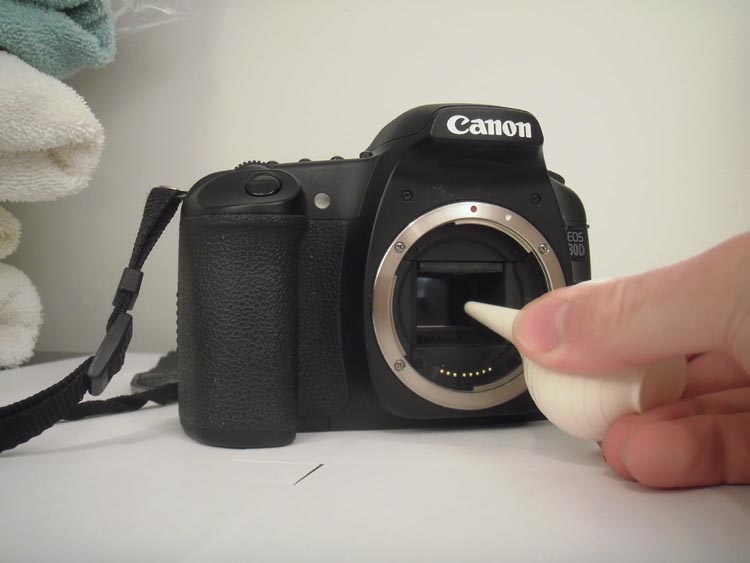
First, the common ear syringe. An ear syringe is just like one of those dedicated sensor blower things that will commonly sell for $10-20. In contrast, the ear syringe does exactly the same thing and can be had for a few bucks at the local drug store. Simply hold the syringe near the sensor and squeeze the bulb, sending a puff of air onto the sensor to dislodge the dust. Unfortunately, some specks of dust adhere themselves unusually well and cannot be blasted off the sensor's surface. This brings us to our next economical dust removal device: compressed air.


A can of compressed air will typically run a couple of bucks for a small one to maybe $5 for one the size of the average spray paint can. Far more powerful than the ear syringe, the windy can is sure to blast away anything the wimpy syringe misses. Whatever you do, don't shake the can up too much and leave the straw off the nozzle. Even one shake should be more than enough power to clean the sensor and as for the straw, they can easily pop off the nozzle and it sure would stink to have your camera's sensor ruined by a flying straw! Oh yes, the compressed air can also work on computers, CD players, and just about anything else, too.
In conclusion, both the ear syringe and the compressed air can clean your camera sensor without touching it (unlike the mini Swiffer, where one bad swipe can cause permanent damage) and not cost a relative fortune (like the blower and tiny vacuum). So, feel free to change your lenses and broaden your photographic horizons as there is really no reason to be afraid of a little dust.
Like What You Just Read?
Why not check out other great stuff about photography, astronomy, associated gear, and how to use it.
Think someone else would find this informative (or at least entertaining)? Use the buttons below to share!
Why not check out other great stuff about photography, astronomy, associated gear, and how to use it.
Think someone else would find this informative (or at least entertaining)? Use the buttons below to share!
Subscribe to:
Posts (Atom)

 Posts
Posts


