Sunday, December 1, 2013

Video: Comet ISON Disintegrating (For Real This Time!)


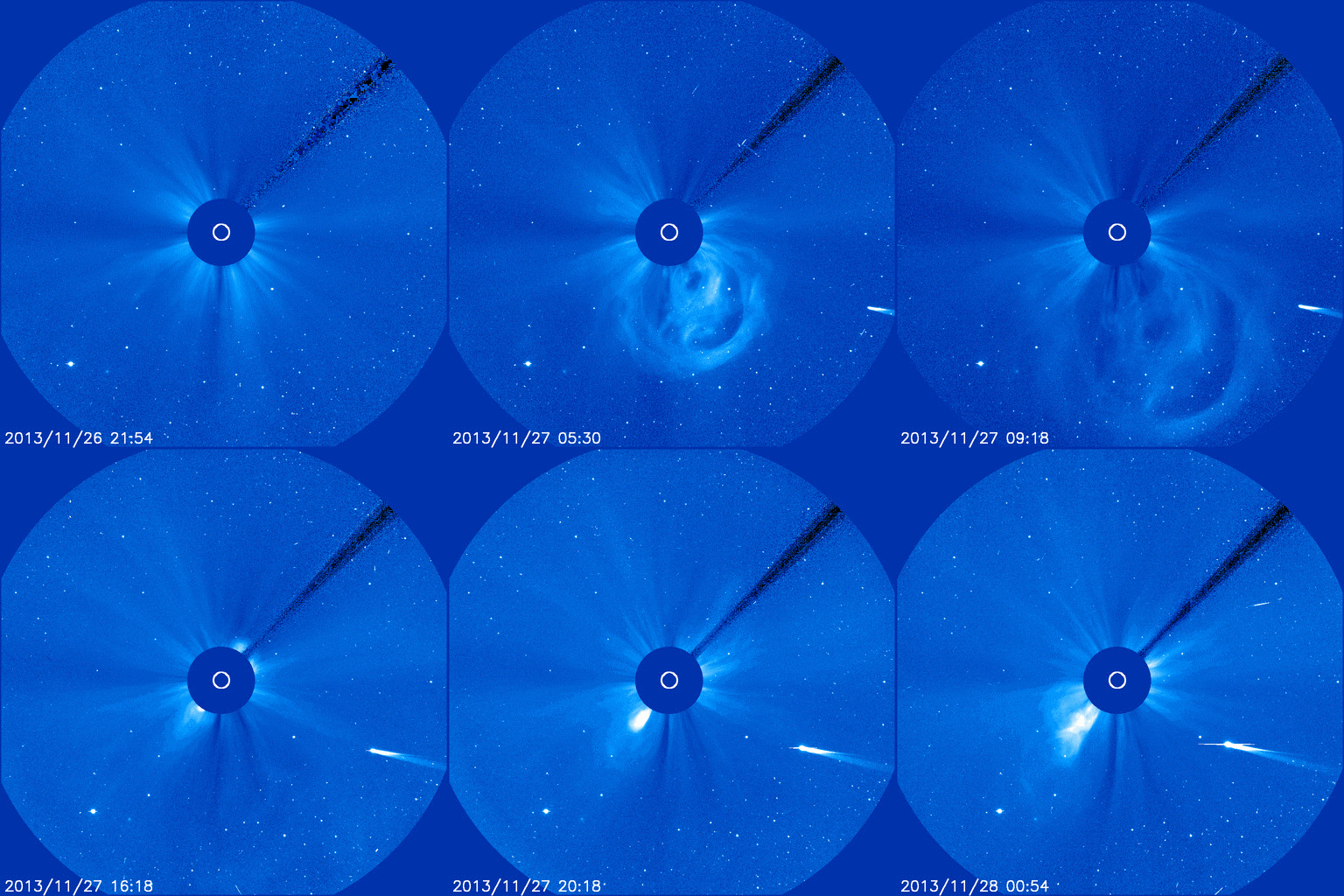
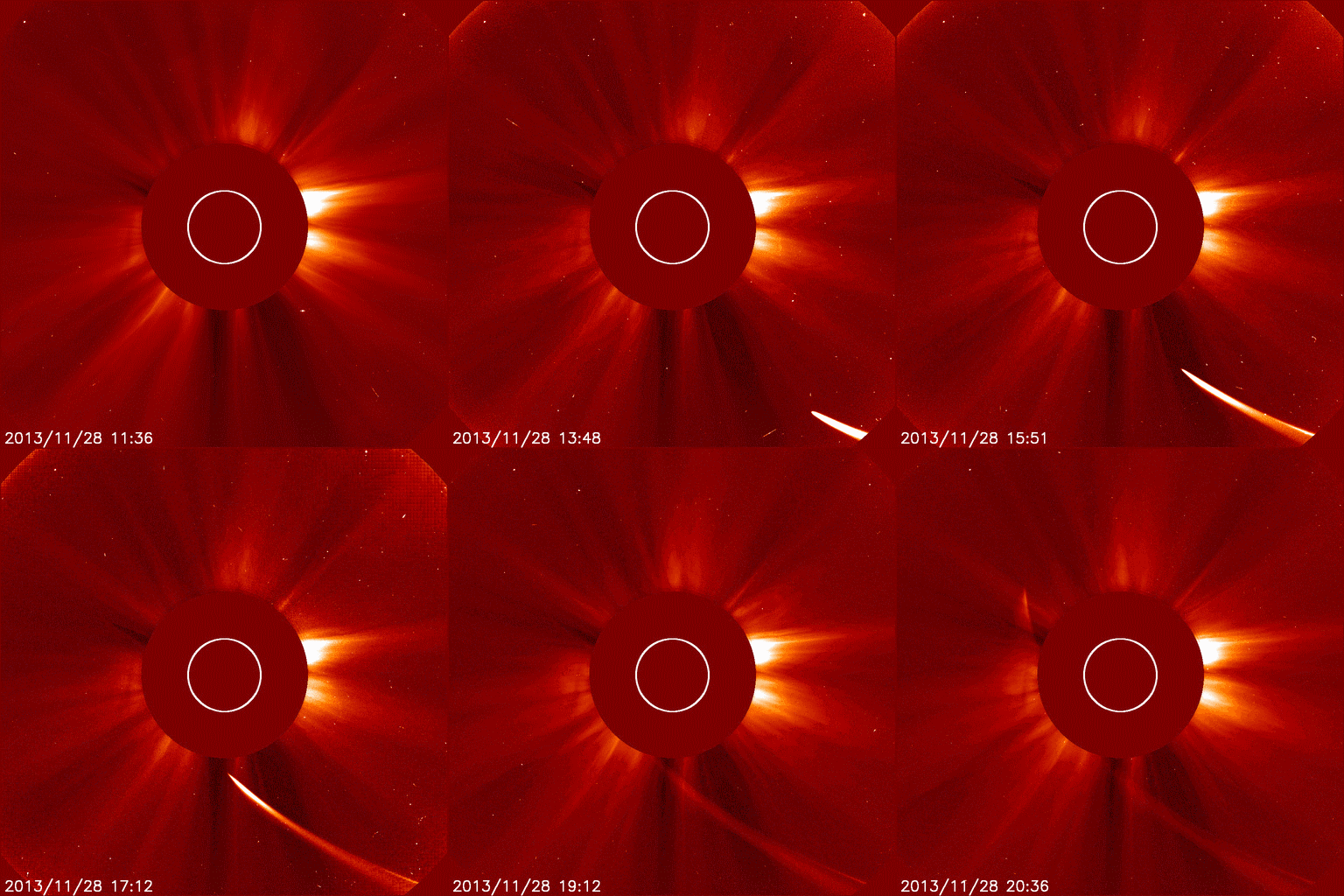
Yesterday came surprising reports that Comet ISON, whose survival some were hailing as a Thanksgiving miracle, was now disintegrating. Well, a day after the news first broke, the bad news is undeniably real as the comet is rapidly dimming and dissipating.Unfortunately, while the previous reports of the comet's 'death' were quickly shown to be premature, this second demise looks to be for real.


See also: the brightest comets in history

It was on Thanksgiving that the comet made its close approach to the Sun, coming within a mere (in astronomical terms) 700,000 miles from our nearest star. Is is this close pass to the Sun, and the resultant melting of the comet that, according to optimistic estimates, could push Comet ISON to magnitude -11, or about as bright as the Full Moon. Unfortunately, though, the same mechanism that could make Comet ISON comet of the decade could also destroy it, which now appears to be the case
Stay tuned for more updates!


Humble Requests:

If you found this informative (or at least entertaining), help me pay my bills and check out my Examiner pages for space news, cleveland photography, national photography, and astronomy for more great stuff.

If you think this was cool, why not tell a friend?

For something even better, follow this blog.

Saturday, November 30, 2013

Breaking News: Comet ISON Disintegrating (VIDEO)


Call the Sun the Grinch as it appears to have just stolen Comet ISON! The latest videos from the SOHO solar observatory are showing a rapidly fading, dissipating Comet ISON racing away from the Sun. Unfortunately, while the previous reports of the comet's 'death' were quickly shown to be premature, this second demise looks to be for real.

See also:
the brightest comets in history

It was on Thanksgiving that the comet made its close approach to the Sun, coming within
a mere (in astronomical terms) 700,000 miles from our nearest star. Is is this close pass to the Sun, and the resultant melting of the comet that, according to optimistic estimates, could push Comet ISON to magnitude -11, or about as bright as the Full Moon. Unfortunately, though, the same mechanism that could make Comet ISON comet of the decade could also destroy it, which now appears to be the case
Stay tuned for more updates!


Humble Requests:

If you found this informative (or at least entertaining), help me pay my bills and check out my Examiner pages for space news, cleveland photography, national photography, and astronomy for more great stuff.

If you think this was cool, why not tell a friend?

For something even better, follow this blog.


Don't forget to check out my other website:

Friday, November 29, 2013

Black Friday Miracle: Comet ISON Survives Perihelion! (PHOTOS, VIDEO)


Miracles are real! It now appears that initial reports (including one here) suggesting that Comet ISON disintegrated have been proven premature thanks to further video (click the above picture to watch) by the SOHO solar observatory clearly showing Comet ISON, or at least part of it, emerging from the other side of the Sun.

So, what could have happened?

Right now, the Sun is near the peak of activity in its regular, 11-year cycles. This means that the Sun is blasting a lot of waves of charged particles (solar wind) out into space. With Comet ISON getting so close to the Sun, it will take a direct, close-range hit should a flare aimed at the comet erupt in the coming days. As for what could happen? While anything exact is far from certain, it appears as though the solar wind could have stripped off a sizable portion of the comet's atmosphere, thus reducing its brightness, and leading to premature expectations of its total demise. The same thing happened to Comet Encke in 2007.

See also: the 10 brightest comets of all time

In the end, though, the only way we'll be able to know what Comet ISON will do is to wait and watch. Hopefully, it will survive its close encounter intact and become a show for the history books when it reappears on the other side of the Sun.


Humble Requests:

If you found this informative (or at least entertaining), help me pay my bills and check out my Examiner pages for space news, cleveland photography, national photography, and astronomy for more great stuff.

If you think this was cool, why not tell a friend?

For something even better, follow this blog.

Don't forget to check out my other website:

Thursday, November 28, 2013

Photo/Video: Comet ISON Appears to Have Disintegrated


New photographic evidence has shown something reappearing on the other side of the Sun, but it hardly looks like Comet ISON. Appearing as a small streak, there is clearly something on SOHO's camera, but all evidence indicates trouble in the form of a 'headless' comet (one that has largely been stripped of its atmosphere and tail) or the remains of a fragmented nucleus. Go here for a video.

AS of now, no one is certain exactly what is going on, but stay tuned for further updates!

Comet ISON Comes to Perihelion Today, Watch it Happen Live!


Comet ISON is coming to perihelion later today! In non-astronomer lingo, this means that Comet ISON is going to make its closest approach to the Sun today, coming to with 732,000 miles (a close very shave in astronomical terms). It is this intense solar heat that will cause the comet to melt at its fastest rate. Why does this matter? Simple: all of the solar light reflected off the water vapor pouring off the comet will give ISON the familiar, tailed comet look.

The best part: you can watch everything happen live (almost) online!

With Comet ISON being lost to visual observers, the only way to see it now is by way of Sun-studying orbital observatories. Mission control for one of these observatories, SDO, will be hosting a Google+ hangout from 1pm to 3:30pm EDT. Go here for a link to the action.

See also: the 10 brightest comets of all time

In the end, though, the only way we'll be able to know what Comet ISON will do is to wait and watch. Hopefully, it will survive its close encounter intact and become a show for the history books when it reappears on the other side of the Sun.


Humble Requests:

If you found this informative (or at least entertaining), help me pay my bills and check out my Examiner pages for space news, cleveland photography, national photography, and astronomy for more great stuff.

If you think this was cool, why not tell a friend?

For something even better, follow this blog.

Don't forget to check out my other website:


Tuesday, November 26, 2013

List: The Brightest Comets of All Time

brightest comets of all time comets bright enough to be seen during the day

In a matter of days, Comet ISON will make its perihelion approach, coming within 750,000 miles (a very close shave in astronomical terms) from the Sun. Both astronomers and the general public have gone abuzz over Comet ISON thanks to a prediction released a year ago by NASA's Jet Propulsion Laboratory (JPL) that stated that the comet could reach magnitude -11.6, or about as bright as the Full Moon. Additionally, besides being shadow-casting bright at night, the comet would be bright enough to easily be spotted during broad daylight.

If this were to happen, it would not be a first, but it would allow Comet ISON to join a very exclusive list of the brightest comets ever seen. To days, only 9 comets in recorded history have been bright enough to be seen in daylight. Now, in chronological order, here they are . . .

Great Comet of 1106.
The Belgian historian Sigebertus Gemblacensis completed his
Chronica in 1111. In it, he wrote that on 1106 February 2 a star appeared during the daytime, between the third and ninth hours, about a cubit from the sun. The probable universal time of this observation was February 2-3. A cubit is roughly equal to one degree, meaning that the comet was in Aquarius. The comet was observed in other European countries as well as in the Orient. Some estimates credit the comet as having a tail spanning 100 degrees at peak.


Great Comet of 1680.
Even if it weren't for its amazing show, the Great Comet of 1680 had another distinction: it was the first comet discovered by telescope. First seen on November 14, 1680, the comet rapidly brightened as it approached perihelion, which took place on December 18, 1680, at which time the comet, which passed within 600,000 miles of the Sun, was reportedly bright enough to be seen in broad daylight. Coincidentally, the Great Comet of 1680 has an almost identical orbit to that of Comet ISON. 


Great Comet of 1743-4.
This comet was discovered simultaneously be several astronomers in November, 1743. At the time, it was reported as appearing as a nebulous star without a tail. By February, 1744 it was as bright as Venus and, after perihelion approach in March, 1744, it developed a spectacular, fan-like tail with 6 prominent streaks. This 6-tailed comet was even observed before it rose, its tail was that bright. The comet then moved into the Southern hemisphere, where some observers credited it with a tail spanning 90 degrees. After 2006-7's McNaught, some came to believe that the Comet of 1743-4 was the first recorded appearance of a comet featuring prominent dust striae.


Great Comet of 1843.
First observed in February of 1843, the comet rapidly brightened to the point it was seen in broad daylight at perihelion, which brought it to about 1 angular degree (or about 830,000 miles) of the Sun. This comet was known for its extremely long tail. At over 2 astronomical units (over 180 million miles), the Comet of 1843 would have the longest measured tail until Comet Hyakutake of 1996 was found to have a tail of over twice that length.


Great Comet of September 1882 (the Super Comet). 
Perhaps the brightest comet ever seen, at peak, some estimate the Great Comet of September 1882 of having had a peak brightness of magnitude -20, rivaling that of the Sun. Initially spotted in either late August or early September 1882, the comet brightened rapidly as it approached perihelion, which took place on September 17. At this time, the comet was reported as being scarcely dimmer than the limb of the Sun, suggesting a magnitude as bright as -20. After perihelion, the comet quickly moved into dark skies, making it perhaps the most spectacular comet ever seen in all of recorded history. The comet remained visible to the naked eye for a long time, until February, 1883, with the last confirmed sighting coming in June, 1883. This comet was also notable in being the first great comet to have been photographed.


The Daylight Comet of January 1910. 
In 1910, comet mania was in high gear with the anticipated return of Halley's Comet set for April. However, in January, a surprise came about in the form of a comet that literally burst into naked eye visibility virtually overnight. Initially observed in the Southern Hemisphere, the comet reached perihelion on January 17 and moved into the Northern Hemisphere thereafter, easily out-shining Venus and having a tail possibly 50 degrees long. Thanks to appearances of Halley's Comet later that year and the passage of decades, many recollections of the two comets were confused when Halley's Comet reappeared in 1986, with the Daylight Comet being falsely remembered as Halley's Comet. 


Comet Skjellerup Maristany (1927).
This comet became very bright in late, 1927, being naked-eye visible for about a month. In mid December, the comet, already notable for its yellow appearance thanks to a shedding of sodium atoms, shot into daylight visibility thanks to a forward scattering of light, provided one blocked the Sun with one's hand. The Comet reached perihelion on December 15 passing within 1.5 angular degrees of the Sun.


Comet Ikeya Seki (1965).
Initially discovered in December, 1965, initial predictions projected a perihelion approach to within 500,000 miles of the Sun coming in mid October and the comet reaching incredible brightness. In this case, the comet lived up to the hype, reaching an apparent magnitude of -10 in October, 1965, becoming visible next to the Sun in daylight near perihelion. After the comet reappeared on the other side of the Sun following perihelion, it sported an extremely bright, long tail. 


Comet West (1976)
Discovered photographically in September, 1975, Comet West was predicted to reach perihelion on February 25 of the following year. At perihelion, observers reported the comet as being bright enough to be seen in broad daylight. Unfortunately, despite its spectacular appearance, comet West was largely ignored by the non-astronomical media thanks to another comet, Kohoutek, which failed to live up to its initial billing as 'comet of the century' in 1973.   


Sunday, November 24, 2013

How Bright Will Comet ISON Get? New Predictions!


Both astronomers and the general public went abuzz over Comet ISON thanks to a prediction released a year ago by NASA's Jet Propulsion Laboratory (JPL) that stated that the comet could reach magnitude -11.6, or about as bright as the Full Moon. Additionally, besides being shadow-casting bright at night, the comet would be bright enough to easily be spotted during broad daylight. If Comet ISON were to become this bright, it would not be a first, but it would still be the astronomical event of the year should the JPL's prediction come true.

Now, less than a week to the (hopefully) big show, some new predictions regarding how bright comet ISON could get have been made.


So, how bright could ISON get? Short answer: no one knows, with everything hinging on whether the comet survives its close approach to the Sun, a point where the experts are in disagreement.

What we do know is as follows. At the start of the month, Comet ISON was shining around +8 magnitude, where it had been for over a month and a half. Then, without warning, the comet's brightness jumped about 2 magnitudes (or about a factor of 5 times) in visual brightness. By the 16
th, the comet was reported as having jumped another magnitude, to about 5th, near the dim end of naked eye visibility. Some current estimates place ISON in the 4th magnitude.

Now, how about that close solar approach?

On November 28, the comet will pass a mere (in astronomical terms) 732,000 miles from the Sun. Is is this close pass to the Sun, and the resultant melting of the comet that, according to optimistic estimates, push Comet ISON to magnitude -11, or about as bright as the Full Moon. Unfortunately, the same event could also melt the comet and cause it to disintegrate and fizzle out altogether. Bottom line: the only way to see what ISON will do is, literally, to wait and watch.

Okay, comet hunters, here are some key dates to consider:
November 28: Comet ISON's closest approach to the Sun, hopefully it will survive and if it does, a spectacular tail (McNaught on steroids) is a very real possibility
Early December: Comet ISON will be visible on both evening and morning skies for mid-Northern observers and circumpolar for the far North
December 26: Comet ISON makes its closest approach to Earth at 39.6 million miles


For an intriguing afterthought, according to comet hunter John Bortle through Spaceweather.com (go to the September 25, 2012 archived page), Comet ISON's path closely parallels that of the
great comet of 1680, which was bright enough to be seen during the day (just like McNaught).


Humble Requests:

If you found this informative (or at least entertaining), help me pay my bills and check out my Examiner pages for space news, cleveland photography, national photography, and astronomy for more great stuff.

If you think this was cool, why not tell a friend?
For something even better, follow this blog.


Don't forget to check out my other website!