Tuesday, May 27, 2014

It's Official: 2014 Cameloparid Meteors a Bust


Three days after they were supposed to peak and no late outbursts later it's now official: the Cameloparid Meteors for 2014 were a bust, which goes to show that, even in 2014, predicting meteor showers is still extremely difficult. 

So, what could have happened? Short answer: there were too many unknowns.

For starters, no one could predict how dense the trail of debris from Comet 209/P LINEAR was is in the first place. Long story short: if there's a lot of junk, there's a lot of meteors, a little junk, only a few meteors. Since Earth had never run into this trail of cometary debris before, there were no precedents on which to rely.

Another mystery was the exact nature of the comet itself. What was known is that this LINEAR has a short orbital period thanks to gravitational influences from Jupiter. Many comets originate billions of miles away from the Sun in the Kuiper Belt or the Oort Cloud, get knocked out of their orbits, speed in toward the Sun, and then disappear back into space again for thousands of years, or even longer. In their inbound journey, these comets melt and shed a lot of debris, which turns into meteors when these tiny space pebbles hit and burn up in our atmosphere. LINEAR was probably once such a comet but, thanks to odd luck, gravitational influences of Jupiter and the other planets redirected it into a close orbit that takes it around the Sun every few years. The problem this presented: if LINEAR made lots of trips around the Sun, it was probably a “spent” comet in that, by now, it had pretty much shed all the debris it was going to shed.

However, there was an interesting possibility. In an interview with space.com, French astronomer Jeremie Vauballion did some calculations and came to an intriguing conclusion: all of the trails of debris shed by the comet between 1803 and 1924 were along roughly the same path, which was the one Earth was set to pass through on the night of May 23-24. On t he other hand, pessimists pointed to the fact that, thanks to its short orbital period and many trips around the Sun, LINEAR could be spent and not a big producer of dust anymore, meaning that, despite all those trips around the same path, not much of anything would be shed by the comet.

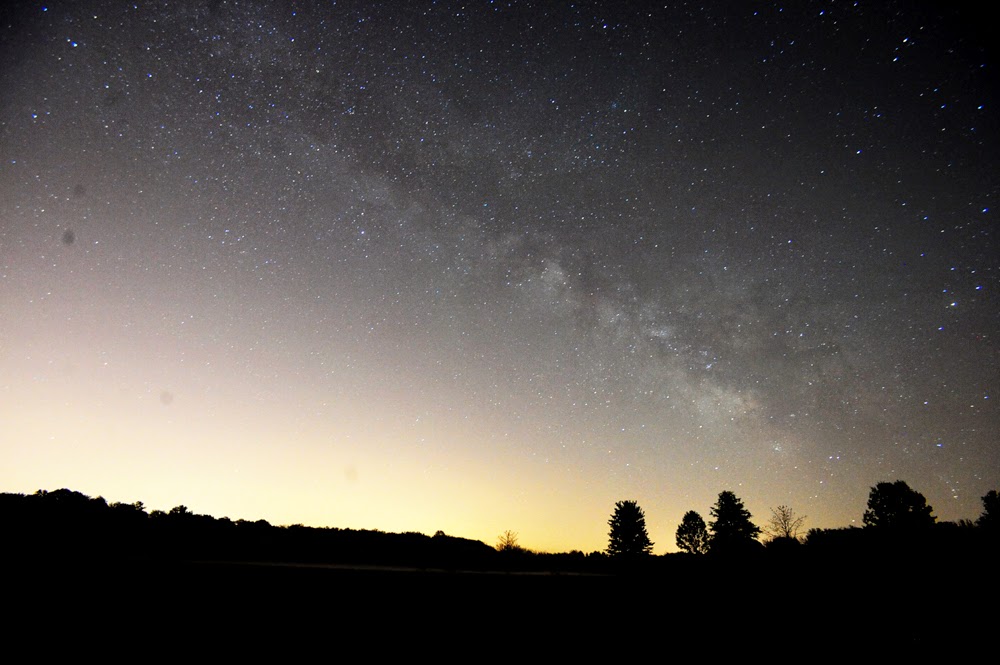
In the end, the conservatives/pessimists won as there was no 200-400 meteor per hour peak and certainly no 1,000 per hour outburst. Still though, it was a lot of fun to spend the night looking up at the sky and through the telescope and taking pictures, keeping one eye on the eyepiece and another toward the sky.

Who knows, the next shower could be very different . . .


Humble Requests:

If you found this informative (or at least entertaining), help me pay my bills and check out my Examiner pages for space news, cleveland photography, national photography, and astronomy for more great stuff.

If you think this was cool, why not tell a friend?

For something even better, follow this blog.


Thursday, May 22, 2014

Comet 209/P LINEAR/Camelopardalid Meteor Shower is Coming, 1,000 Meteors per Hour Possible!


In just two nights, Earth will pass through a stream of debris shed by the short-period comet 209/P LINEAR, which will produce a meteor shower that will radiate from the obscure constellation of Camelopardalis, which is located near the North Celestial Pole. For observers living in the Continental United States (and Alaska), the show will be well-positioned for its 2-4am peak on Friday morning. To make matters better, the Moon will be a non-factor, too.

See also: the greatest meteor storm in history

So, how are things looking in regards to the shower? Well, it depends on who you ask!

First the certain. Earth will definitely pass through a trail of cometary debris on the Night of May 23-24, reaching the deepest concentration between 2 and 4am EST. The meteors will appear to radiate from the obscure constellation of Camelopardalis, which is located between the more famous constellations of Ursa Major and Cassiopeia, which are easy to find for even inexperienced star gazers.

Now for the unknowns.

For starters, no one knows how dense this trail of debris is in the first place, which will have a direct impact on whether these meteors sizzle or fizzle. Long story short: if there's a lot of junk, there will be a lot of meteors, a little junk, only a few meteors. This being a new shower, no one knows what to expect.

Another interesting possibility: in an interview with space.com, French astronomer Jeremie Vauballion did some calculations and came to an intriguing conclusion: all of the trails of debris shed by the comet between 1803 and 1924 were along roughly the same path, which is the one Earth will pass through on the night of May 23-24. On the high end, some estimates place meteor rates at 1,000 per hour, though many are far more conservative.

However, other research is decidedly less optimistic, suggesting that 209P/LINEAR, thanks to its short orbital period and many trips around the Sun, barely produces any dust anymore, having shed most of all of what it could shed eons ago, meaning that, despite all the debris shed for those 121 years between 1803 and 1924, there might not be much floating in space for Earth to run into. .

Bottom line: no one knows what's going to happen until the night of May 23-24 arrives, so hope for clear skies. If you can, stay up (or get up early) and head out, turn your eyes skyward, and hope for the best, which could be spectacular.


Humble Requests:

If you found this informative (or at least entertaining), help me pay my bills and check out my Examiner pages for space news, cleveland photography, national photography, and astronomy for more great stuff.

If you think this was cool, why not tell a friend?


For something even better, follow this blog.

Tuesday, May 20, 2014

What is a Camelopardalis (Besides a Meteor Shower)?


In case you didn't know, Comet 209/P LINEAR is expected to produce a meteor shower this week, peaking the night of May 23-4 at roughly 2-4pm EDT. Now, as befitting traditional rules of meteor shower naming, the meteors aren't going to be named for their parent object, but for the constellation from which they originate, in this case, the constellation of Camelopardalis.

Constellation what?

Needless to say, more than a few people were left scratching their heads when they heard of this constellation, which is one that most people have probably never heard of at all. Camelopardalis is located between the more famous constellations of Ursa Major and Cassiopeia, which means that anytime is a good time to view the shower because the constellation is near the circumpolar region of sky. Another plus: the Moon will be out of the way, too.

Location aside, what is a Camelopardalis, anyway?

Short answer: a giraffe.

For the longer answer, the word 'camelopardalis' is a combination of two words in the Greek, one meaning 'camel' and the other 'leopard.' The reason? A giraffe looks a little like a camel but has spots like a leopard. AS for the constellation itself, it was first categorized as a constellation in 1612 (or 13 depending on the source) by Petrus Plancius, who was a Dutch astronomer and clergyman, to represent the animal Rebecca rode on the trip to marry Issac in the Bible. In the following years, more people recognized the constellation as such and it eventually became one of the 88 constellations canonized by the International Astronomical Union (IAU) in 1922.

As for the shower itself, there's still some uncertainty as to how it will behave, so stay tuned as I'll be sure to post another update as the time draws closer . . .


Humble Requests:

If you found this informative (or at least entertaining), help me pay my bills and check out my Examiner pages for space news, cleveland photography, national photography, and astronomy for more great stuff.

If you think this was cool, why not tell a friend?


For something even better, follow this blog.

Monday, May 12, 2014

Comet 209P/LINEAR Could Produce Meteor Storm May 23-24, 400 Meteors Per Hour Possible


Mark your calendars for the night of May 23-24 as Comet 209P/LINEAR could produce a meteor storm (optimistic forecasts predict as many as 400 meteors per hour under ideal conditions) as Earth is set to pass through a trail of debris shed by the comet, which was only discovered in 2004. The best part: us in the United States are best suited to see the event.

So, what's up?

First the certain. Earth will definitely pass through a trail of comet debris on the Night of May 23-24, reaching the deepest concentration between 2 and 4am EST. The meteors will appear to radiate from the obscure constellation of Camelopardalis, which is located between the more famous constellations of Ursa Major and Cassiopeia, which means that anytime is a good time to view the shower. Another plus: the Moon will be out of the way, too.

Now for the unknowns.

For starters, no one knows how dense this trail of debris is in the first place, which will have a direct impact on whether these meteors sizzle or fizzle. Long story short: if there's a lot of junk, there will be a lot of meteors, a little junk, only a few meteors.

Another interesting possibility: in an interview with space.com, French astronomer Jeremie Vauballion did some calculations and came to an intriguing conclusion: all of the trails of debris shed by the comet between 1803 and 1924 were along roughly the same path, which is the one Earth will pass through on the night of May 23-24.

However, other research is decidedly less optimistic, suggesting that 209P/LINEAR, thanks to its short orbital period and many trips around the Sun, barely produces any dust anymore, having shed most of what it could shed eons ago.

Bottom line: no one knows what's going to happen until the night of May 23-24 arrives, so hope for clear skies. If you can, stay up (or get up early) and head out, turn your eyes skyward, and hope for the best, which could be spectacular.


Humble Requests:

If you found this informative (or at least entertaining), help me pay my bills and check out my Examiner pages for space news, cleveland photography, national photography, and astronomy for more great stuff.

If you think this was cool, why not tell a friend?

For something even better, follow this blog.


Monday, May 5, 2014

Life Size vs. Half Life Size Macro: How Big Is the Difference?


Should I buy a 1:1 (life size) or a 1:2 (half life size) macro lens? That's a common question asked by many a beginning macro photographer. The problem: life size is the now standard spec for current macro lenses but old, half life size models from the beginning of the AF era (or even the MF era for that matter) can be had for a fraction of the cost of a modern macro.


So, how big is the difference? Well, look below to see.


As you can see, the difference between life and half life size (not to mention double life size) is very noticeable indeed, with the life size quarter appearing to be about 4 times bigger than the half life size one. As for why the huge difference, it is thanks to the fact that the image is a 2 dimensional object and, by shrinking each axis by a factor of 2, you get a total shrinkage of a factor of 4 (½ x ½ = ¼).

Now, that's quite a loss but there are two ways around the problem: cropping in Photoshop or extension tubes.

As you can see on the above picture, I could easily just crop the half life size image to be the equal of the life size one. Unfortunately, by doing this, I would be eliminating ¾ of the original image's resolution in the process, which presents another problem: can I afford to lose 75% of my pixels.

For 99% of people reading this, the answer is 'yes!'

Modern dSLR cameras have insane resolutions of at least 16Mp, which is way, way more than most people will ever need. Take it from someone who has been doing this since high school: you don't need massive pixel counts to get great prints. In high school, we were sometimes using 3Mp images (state of the art in the early 2000s) to fill 11x14 pages. Result: they looked great!

Don't print? No problem as all affordable computer and TV screens are 1920x1080 pixels in resolution, which translates to a measly 2Mp, which is half of the 4Mp you would get by cropping a 16Mp half life size image to the equivalent of a life size one. Bottom line: whether you show off your images on screen or on paper, you'll have plenty of resolution to send your audience members' jaws dropping to the floor provided you know how to shoot macro. 
 
Work around #2: extension tubes.
 
For anyone in the know, extension tubes are merely lens accessories without glass that mount to the rear of a lens, extending the lens and increasing the magnifying effect. Whatever your make, extension tubes can be had from manufacturers or third parties, thus making it easy to boost the native magnification power of a lens, whether that lens has a native magnification factor of 1:2 or 1:1.  


My advice: save the cash, buy the 1:2 lens, and crop your pictures or buy extension tubes if you must need to keep all your pixels. After all, money doesn't grow on trees.


Like What You Just Read?


Why not check out other great stuff about photography, astronomy, associated gear, and how to use it.

Think someone else would find this informative (or at least entertaining)? Use the buttons below to share!

Monday, April 21, 2014

The Blood Moon Prophecy Debunked


It was a week ago that the world was treated to a total lunar eclipse, also known as a “blood moon” thanks to the fact that the eclipse turns the Moon red. Additionally, last week's eclipse marks the first in a series of 4 consecutive total lunar eclipses (somewhat of a rarity) known as a tetrad. If that weren't enough, the eclipse brought about a flood of doomsday predictions, too. Why you ask?

Well, blame the redness of the Moon.

Starting in 2008, pastor Mark Biltz began teaching that the Second Coming was near. How does he know that? According to Biltz, he has discovered astronomical patterns (which he refuses to reveal) that led him to believe that the next tetrad of eclipses would coincide with the end times. Using technology such as his website and Youtube to spread his message, Biltz quickly built a cult-like following with modern-day doomsday believers, a following that has grown into all-out hype now that the tetrad in in process.

Cue our next prophet of doom.

Writing in his 2013 book
Four Blood Moons: Something is About to Change, John Hagee notes that the last three tetrads corresponding to the Jewish feasts of Passover and Sukkot (as this current one does) correspond to pivotal events in the history of the Jewish people: the expulsion of the Jews from Spain (1492-3), the founding of modern Israel (1949-50), and the Six Day war (1967-68). As a result, thanks to the “rarity” of tetrads and their past correspondences with important events in the history of the Jews, Hagee predicts that something big is just over the course of the horizon that could mark a dramatic shift in the fortunes of the Jewish people, and, thanks to the global society we now live in, the world as a whole.

Now for facts.

For starters, Tetradds are not all that rare as there have been 62 of them in the past 2,000 years. That equates to a tetrad about every 30 years, meaning that, on average, a person will see two of them in a lifetime. As for tetrads that have eclipses falling on Passover and Sukkot, those are rarer, with only 8 of the 62 falling on such dates. Still, with about 1/8
th (12%) of tetrads having eclipses falling on these two holidays, the whole tetrad-Passover-Sukkot alignment doesn't look all that rare anymore, after all, does it?

As for the other tetrads falling on these two holidays, they took place in the following years: 162-2, 795-6, 842-3, and 860-1.

Now, even with the tetrads not being all that rare in themselves, isn't it still an oddity that they happen to fall on these important Jewish holidays? Well yes, that is until you learn that the ancient Jewish calendar (still used for determining the dates of religious holidays) is a Moon-based calendar! Gee, Full Moons (the only time a lunar eclipse can occur) on dates of major holidays now have a perfectly rational explanation.

Now, as for the implication that a series of 4 consecutive total eclipses leads to pivotal events in the history of the Jewish people, this is an extreme example of the logical fallacy post hoc ergo propter hoc (“after this, therefore because of this” in Latin), which is basically false causal reasoning, an argument based on the assumption that two completely different events are related to one another in that Event A causes Event B. Example: you see a black cat (Event A) on your way to work and have a bad day at work (Event B), so you assume that the black cat caused you to have a bad day at work. Pretty stupid, huh? Well, not according to the millions of people who pushed
Blood Moons
into the bestseller category on Amazon, where it has remained in the top 150 titles essentially since its release.

In reality, there is only a single way that the Moon has any measurable impact of events here on Earth: its gravity. Want to see proof of this? Look no further than the famous
Bay of Fundy and its tides. Gravity aside, the Moon does nothing for us here on Earth, except scare the gullible, apparently.

Hagee's false causal reasoning exposed for what it is, how about Biltz and his interpretation of the Bible?

For fundamentalist Christians, the Bible is literal truth, case closed. However, even for the most devout Bible th
umper out there, there's no denying that the holy book can be very vague at times. Let's take a look at the verses Joel 2:30-31, which state that “30 And I will show wonders in the heavens and on the earth, blood and fire and columns of smoke. 31 The sun shall be turned to darkness, and the moon to blood, before the great and awesome day of the Lord comes.” This is the passage that Biltz uses as the basis for his Doomsday prediction.

Okay, there is no doubt that, if one applies natural events to this “prophecy,” the events spoken of here can only be a solar and lunar eclipse. Problem: eclipses
occur in cycles thanks to celestial geometry. Result: a lunar eclipse at Full Moon is often followed by a solar eclipse at New Moon, roughly 2 weeks later. Bottom line: eclipses often follow each other, though having the perfect alignment for a pair of total eclipses is rarer, it's nothing that unusual. Doing a little math with the roughly 6-month eclipse seasons, that's roughly 4,000 such cycles in the last 2,000 years, which means that such a succession of events is nothing unusual at all.

In the end, what do we have? Well, after reading this, two prophets of doom with theories filled with more holes than a block of Swiss Cheese.?

Case closed.


Humble Requests:

If you found this informative (or at least entertaining), help me pay my bills and check out my Examiner pages for space news, cleveland photography, national photography, and astronomy for more great stuff.

If you think this was cool, why not tell a friend?


For something even better, follow this blog.

Sunday, April 13, 2014

Sigma 50 f1.4 Art to Sell for $949, Manufacturers Officially Screwing Us Over


Sigma has just announced that its much-anticipated 50 f1.4 Art lens will be hitting stores late this month for $949. While not cheap in absolute terms, the $949 price tag is about half of comparable products from the camera manufacturers. If that weren't enough, it appears as though the Sigma will trounce the competition on the performance front, too.

Breaking news: the name brand companies are screwing us over.

It is not new news that name brand camera makers (Canon, Nikon, etc.) charge a premium for their optics when compared to third party (Sigma, Tamron, Tokina) products with similar specifications. However, unlike 20 years ago, third party no longer equates to third rate, far from it. In fact, third party offerings are now not only often equal to manufacturer goods on the spec sheet, but in the field, too, which begs a question: why do people keep paying for over-priced products?

Short answer: snob appeal.

I hate to say it, but when pitted against the excellent Sigma, the name brand alternatives from the manufacturers (Canon, Nikon, and Sony) simply can't compare to the Sigma for the reason of price alone. The top of the line fast 50s (58 for Nikon) all cost upwards of $1,700 and perform no better (in fact, worse) than the Sigma. Want proof? Start reading reviews as the Canon 50 f1.2L is nearly a decade old, there are already plenty of reviews for the 50 f1.4 'Noct' Nikkor. Findings? Both lenses are, unlike the Sigma, anything but sharp at widest aperture ( the reason you're supposed to buy them) and as for the Sony-Zeiss 50 f1.4 collaboration (itself still just starting to hit stores), even if it were as good as the Sigma, it still costs over $500 more.

In the end, what are people paying all of this extra money for? Short answer: a nameplate (at least Canon throws in a fancy red ring on the lens barrel) and the bragging right of being able to say that they don't have a mismatched set of gear..


So what's a snob who doesn't want to pay through the nose to do? Answer: boycott your manufacturer.

We in America live in a free market capitalist economy where the customer has the power. Don't like a product or think it costs too much? Tell people and, if enough people collectively decide to boycott something, the manufacturer will have to address the concern as by not doing so, it will lose a lot of sales and money. Bottom line: if every Canon, Nikon, and Sony shooter decided to boycott their manufacturer's fast 50 offerings, prices would drop in a hurry to be more in line with the Sigma, which has gone to show that it is possible to offer premium, manufacturer-grade fast 50mms for under $1,000.

Unfortunately, snobs being snobs (and snobs often being rich), this will never happen. However, that doesn't make the Sigma 50 f1.4 Art disappear into thin air, so buy this lens instead as Sigma has demonstrated that Canon, Nikon, and Sony have no right to pick our pockets to the tune of $1500+, that is unless we're stupid enough to let them do so.


Humble Requests:

If you found this informative (or at least entertaining), help me pay my bills and check out my Examiner pages for space news, cleveland photography, national photography, and astronomy for more great stuff.

If you think this was cool, why not tell a friend?

For something even better, follow this blog.